
Settlement & Payouts
Balance changes follow settlement statements rather than updating in real time. This page explains the settlement mechanism, revenue composition, the pending-to-withdrawable flow, and payout methods and arrival.
Reported data vs. settled data
There are two sets of figures in the console — be sure to tell them apart:
| Figure | Update frequency | Meaning |
|---|---|---|
| Performance data (impressions/clicks/CTR/estimated spend/estimated revenue) | Near real-time | A "near real-time" estimate, for observing performance |
| Account balance (advertiser balance / publisher withdrawable balance) | Updated at settlement | The actual amount after real debits/credits occur |
So advertisers see "current balance" alongside "estimated spend/estimated balance", and publishers see "withdrawable balance" alongside "pending/estimated revenue". Estimates are for monitoring performance; the settlement statement is final.
Settlement mechanism
Only valid traffic is billed. If counted traffic is later found invalid, it is adjusted in a later settlement; the settlement statement is final.
Revenue composition (revenue share)
The amount generated by each valid traffic event is split between advertiser cost and publisher revenue by a revenue-share ratio:
- By default 70% goes to the publisher, with the rest as the platform service fee.
- On the advertiser side it's recorded as cost, deducted from the balance; on the publisher side it's recorded as revenue, credited to pending.
TIP
The revenue share is reflected in the gap between "the cost the advertiser pays" and "the revenue the publisher receives". The revenue a publisher sees is the amount after the revenue share is applied.
Pending → withdrawable
A publisher's revenue can't be withdrawn the moment it settles — it's held for a period first:
- Revenue first enters the pending balance.
- Pending revenue is released to the withdrawable balance once a week. Revenue credited within the last 7 days (the hold period) stays pending until a later release, so in practice revenue becomes withdrawable about 7–14 days after it settles.
- A release happens only when at least $50 is releasable; smaller amounts keep accumulating.
- Only the withdrawable balance can be paid out.
The hold period is part of our standard payout terms.
Payout methods and arrival
When the withdrawable balance is sufficient, request a payout. Withdrawals require completed identity verification (KYC). Available channels:
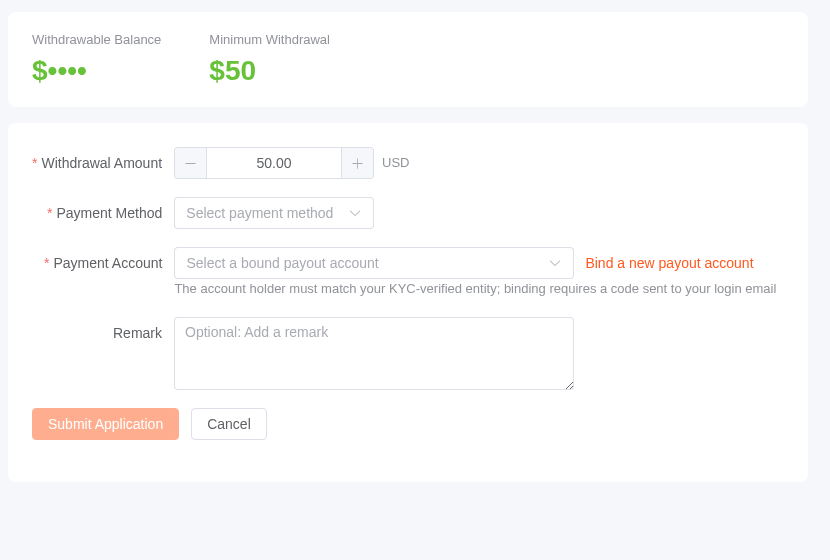
The withdrawal form checks your withdrawable balance against the minimum payout before it lets you submit.
| Channel | Description |
|---|---|
| USDT | USDT (TRC20 / ERC20) to a specified wallet address |
| Bank transfer (BANK) | Transfer to your bank account |
Payout rules:
- Minimum payout — $50; bank transfer starts at $100. The exact minimum per channel is shown on the withdrawal form.
- Fees and taxes — arrival amount = payout amount − fee (per channel rate) − tax (if applicable). The estimated arrival is shown when you initiate.
- Receiving account — you must first add and verify the receiving account for the channel; it must be in the same name as your verified identity.
- Hold mechanism — after a payout is initiated, the amount is frozen from the withdrawable balance, awaiting admin review and disbursement.
- One in flight — only one pending payout at a time; wait for the previous one to complete before starting the next.
Arrival time
Payouts require admin review before disbursement, and arrival time varies by channel. Make sure your receiving account details are correct — incorrect info may cause failure or delay.
FAQ
| Question | Answer |
|---|---|
| Why doesn't the balance change in real time? | Balance follows settlements; real-time figures are estimates. |
| Estimated spend is higher than the actual charge? | Normal — the settlement statement is final. |
| When can revenue be withdrawn? | Pending revenue is released weekly once it is past the 7-day hold (and at least $50 is releasable); it is then withdrawable. |
| How long does a payout take to arrive? | After admin review, disbursement follows the channel; time varies by channel. |